There are some general rules when introducing fitness into a child’s life, and there is also a lot of misinformation.
For instance, the whole “weightlifting can damage growth plates” idea that is now “common knowledge” is very, very misleading. In fact, it is inaccurate. That myth is based on a Japanese study in the 1940’s that used children working in a dirty mine as their sample! Yes, too much weightlifting can cause damage, but under professional supervision, strength training can be a safer environment than competitive sports.
Exercise at a young age, including strength training, is a vital part of a child’s physical, emotional, and mental development. In the book “The new Science of Exercise and the Brain”, the author talks about how exercise aids brain development and learning by creating new neurons in the brain. This is revolutionary information that will radically transform our school system, hopefully sooner than later.
In general, it is best to introduce physical activity in a non-competitive setting first. This decreases the risk of injury and will prevent children who are poor performers in sports from getting turned off to physical activity in general. It also provides more control over the environment, ensuring a positive first experience with organized physical activity. Unfortunately, many schools present their children only two options: sports or inactivity. Fitness can teach them to compete with themselves, create and achieve goals, and self-empowerment, all while building self-esteem. When a child does not perform well at a sport or sports in general, competitive sports lowers self-esteem. Fitness is a great alternative.
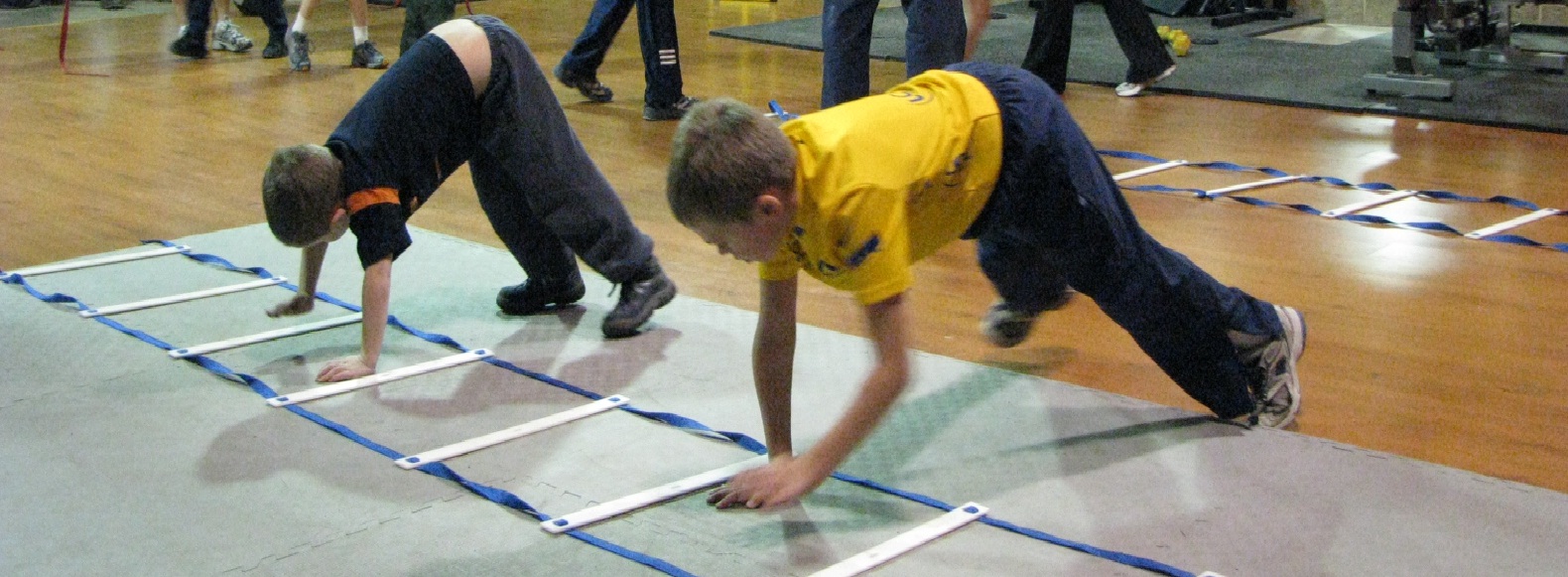
Most research indicates that 5 years old is an appropriate age for MOST children to begin some type of exercise. Again, under expert supervision, they can start as early as 3 years old with certain basic activities. Issues with damaging a child’s body are decreased greatly with the concept of micro-progression, in which the child starts with very easy “control exercises” and very slowly progresses from there. From a physiological perspective, where the force comes from (weights, water, a ball or sport, their own body etc.) is irrelevant in and of itself. Properly prescribing and then progressing forces slowly is the key to successful adaptation.
There are many ways in which exercise and sports can teach teamwork and emotional development. Partner dancing has been taught in some school systems to utilize exercise for social development of pre-teens. While dancing, new neurons are created, which are then utilized for navigating a socially challenging situation (dancing with a partner of the opposite sex. EWWW!).
Contrary to popular belief, weightlifting can be a very valuable tool to introduce to children even before sports. Under the correct supervision, the child can practice controlling weights that are well within their skill and strength level, instead of pushing their limits in a competitive setting. This controlled environment is safer then sports and can then decrease the risk of injury when they enter that competitive environment.
Unfortunately, the government, the media, and popular culture dismiss fitness and physical activity for young students as a luxury. Nothing could be further from the truth. Physical fitness is a sure way to help your child grow socially, emotionally, physically, and intellectually, all while teaching them how to overcome challenges, work together, and achieve goals. Exercise is a tremendous vehicle for self-empowerment and self-mastery, and is an essential element of education that should be brought back to the foreground of our national conscience.
To start your child on the right path to fitness, please contact Total Human Performance for a free consultation by using our contact form located at http://www.totalhumanperformance.net/about-us/contact-us/ today!