Category: Conditioning

  • Cycling For Weight Loss

    Cycling For Weight Loss

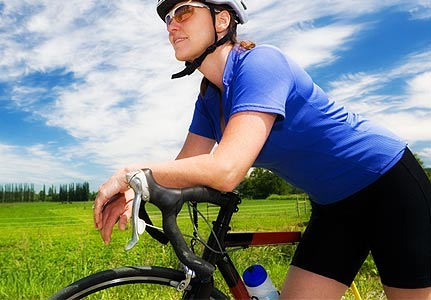
    Losing weight cycling is a fun and enjoyable way to improve your health and to make you feel better. Pedaling down a rural road or through a city park rouses your spirit and awakens your senses.

    One of the most powerful arguments for encouraging more people to cycle is that it leads to considerable improvements in public health.   A regular routine to lose weight cycling can reduce the risk of serious conditions such as heart disease, high blood pressure and obesity.

    Cycling is also a good way to improve your balance and co-ordination.   They say once you learn to ride a bike you never forget and that is true. The motion and balance come back to you very quickly. If you’re looking to get outside more often and improve your fitness, biking is the answer.  It enhances your general well-being and promotes mental health. Beyond the health benefits, it’s an enjoyable way to get around.

    Getting on your cycling bike regularly can also be an effective form of aerobic exercise.  A recent study found that even a small amount of cycling for weight loss can lead to a significant fitness gain. Aerobic fitness was boosted by 11 percent after just 6 weeks of cycling short distances four times a week. 

    Cycling can have positive effects on how we feel too.  Moderate exercise has been found to reduce levels of stress and depression, improve mood and raise self esteem. It has also been found, in some instances, to relieve symptoms of PMS.  Benefits in strength and agility can come from regular cycling also. There are no real-age barriers to cycling and people at almost any fitness level can begin slowly and gently if necessary.

    Physically active older people can reduce the rate of hip fractures with regular cycling exercise. Most of the negative things we associate with aging aren’t a result of chronological aging but rather a lack of physical activity.  Cycling is as gently on your body as a sport can be. It is a non weight bearing exercise so it’s easy on your joints, even the achy ones. It can be a wonderful way to get exercise and lose weight without pain.

    If your looking to lose weight cycling, jump on your bike and leave your worries and stress at home. Enjoy your ride. Just think you could be at work instead.

    If you are interested in starting a weight loss plan, or interested in cycling basics, please contact Total Human Performance for a free consultation by using our contact form located at http://www.totalhumanperformance.net/about-us/contact-us/ today!
  • Fitness for the Average Golfer

    Fitness for the Average Golfer

    Although some professional golfers don’t look like athletes, the fact remains that golfers are athletes.  These days, a more careful look at the professional golf ranks will reveal many well-conditioned people.  Such conditioning is needed to perform consistently well at a high level.  After all, it isn’t often noted, but the golf swing is an intensely athletic motion.

    Given that fact, even the most casual golfer who incorporates the simplest of exercises can help himself or herself shave strokes off the handicap, and maybe a few inches off the waist.

    A golf analysis company based in Germany, Golf Biodynamics, conducted a study using twenty-eight weekend golfers. They were introduced to an eight-week, “five-column” workout plan.  The five columns were different sets of exercises that concentrated on five different fitness-related aspects of golf – coordination, balance, strength, the swing itself, and flexibility.

    The results of the study were overwhelming.  The group as a whole experienced an increase in upper-body rotation and an 80 percent gain in upper-body strength.  The stability of their hip rotation also increased, resulting in a more controlled swing, and their collective clubhead speed increased by 9.4 percent.  Think they’re having fun knocking their drives past their playing partners now?

    As with any workout regimen, the older a person gets, the harder it is to see results.  Younger golfers and women, all with lower handicaps, saw more immediate results on the golf course.  But seniors and bogey golfers can take heart; the sport is a game of inches.  The slightest change any golfer makes can have a significant impact in his or her game, and will help avoid back pain, knee pain, and other health problems many middle-aged to senior golfers experience.

    No matter the age or skill level, a complex golf fitness program can keep golfers swinging away and enjoying the game for many years.  If you are interested in starting a fitness progam today, contact Total Human Performance today at  http://www.totalhumanperformance.net/about-us/contact-us/

  • Introducing Your Child To Physical Activity And Fitness

    Introducing Your Child To Physical Activity And Fitness

    There are some general rules when introducing fitness into a child’s life, and there is also a lot of misinformation.

    For instance, the whole “weightlifting can damage growth plates” idea that is now “common knowledge” is very, very misleading.  In fact, it is inaccurate.  That myth is based on a Japanese study in the 1940’s that used children working in a dirty mine as their sample! Yes, too much weightlifting can cause damage, but under professional supervision, strength training can be a safer environment than competitive sports.

    Exercise at a young age, including strength training, is a vital part of a child’s physical, emotional, and mental development.  In the book “The new Science of Exercise and the Brain”, the author talks about how exercise aids brain development and learning by creating new neurons in the brain.  This is revolutionary information that will radically transform our school system, hopefully sooner than later.

    In general, it is best to introduce physical activity in a non-competitive setting first.  This decreases the risk of injury and will prevent children who are poor performers in sports from getting turned off to physical activity in general.  It also provides more control over the environment, ensuring a positive first experience with organized physical activity. Unfortunately, many schools present their children only two options: sports or inactivity.  Fitness can teach them to compete with themselves, create and achieve goals, and self-empowerment, all while building self-esteem.  When a child does not perform well at a sport or sports in general, competitive sports lowers self-esteem.  Fitness is a great alternative.

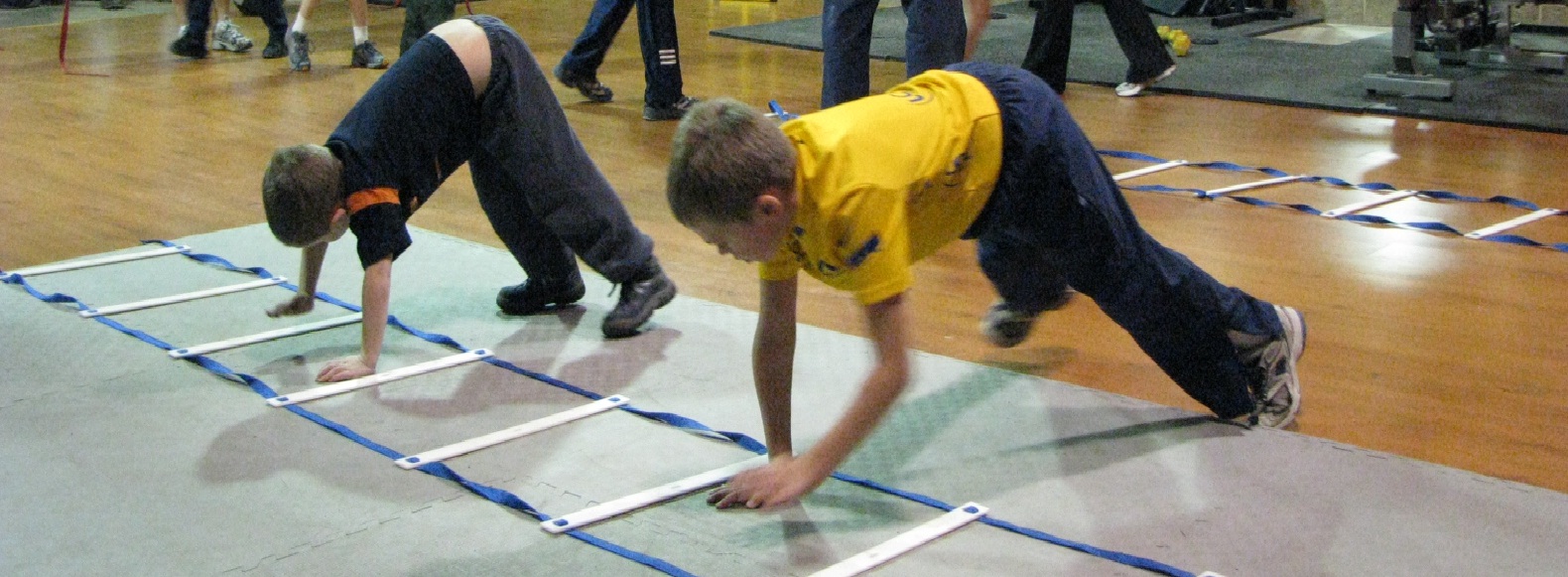
    Most research indicates that 5 years old is an appropriate age for MOST children to begin some type of exercise.  Again, under expert supervision, they can start as early as 3 years old with certain basic activities.   Issues with damaging a child’s body are decreased greatly with the concept of micro-progression, in which the child starts with very easy “control exercises” and very slowly progresses from there.  From a physiological perspective, where the force comes from (weights, water, a ball or sport, their own body etc.) is irrelevant in and of itself. Properly prescribing and then progressing forces slowly is the key to successful adaptation.

    There are many ways in which exercise and sports can teach teamwork and emotional development.   Partner dancing has been taught in some school systems to utilize exercise for social development of pre-teens.  While dancing, new neurons are created, which are then utilized for navigating a socially challenging situation (dancing with a partner of the opposite sex.  EWWW!).

    Contrary to popular belief, weightlifting can be a very valuable tool to introduce to children even before sports. Under the correct supervision, the child can practice controlling weights that are well within their skill and strength level, instead of pushing their limits in a competitive setting.  This controlled environment is safer then sports and can then decrease the risk of injury when they enter that competitive environment.

    Unfortunately, the government, the media, and popular culture dismiss fitness and physical activity for young students as a luxury. Nothing could be further from the truth.  Physical fitness is a sure way to help your child grow socially, emotionally, physically, and intellectually, all while teaching them how to overcome challenges, work together, and achieve goals.  Exercise is a tremendous vehicle for self-empowerment and self-mastery, and is an essential element of education that should be brought back to the foreground of our national conscience.

    To start your child on the right path to fitness, please contact Total Human Performance for a free consultation by using our contact form located at http://www.totalhumanperformance.net/about-us/contact-us/ today!