Blog

  • Six Tips to Snap Out of a Fitness Rut

    Six Tips to Snap Out of a Fitness Rut

    No matter what the fitness level of an individual, we can all get stuck in a rut from time to time.  There are lots of different things that can slow us down, but fortunately there are also lots of ways to spark your workouts again.


    Variety is the spice of life and is a great way to improve your fitness outlook.  People should try to change up the way they exercise now and then to avoid plateaus, boredom and just to give muscles a break from being used the same way over and over.

    Here’s a six-pack of tips to snap out of a fitness rut:

    Keep a workout log – This is a workout must.  If you log your workouts it will allow you to follow a plan, chart your progress and be able to look back over the workouts and feel good about yourself.  It can help you adjust better as you go along – determine what’s working and what isn’t – and also serve as motivation.

    Seek variety – Seek ways to cross train and vary the number of reps you do and how you do them to change things up.  Mixing different types of interval training is a great way to keep your cardio workouts more enjoyable and challenging.

    When it comes to running and/or walking, change the course you exercise on.  A change of scenery could help re-energize you.

    If you train mostly on a treadmill, you can still change things up.  Switch the pre-programmed workout you do, or change surroundings by doing things such as playing different music or what you watch on TV if one is near your machine.

    Set goals – It’s important to set a long-term goal, such as run a 5K race or lose 15 pounds.  People should also set short-term goals, such as simply to make sure they work out three times in the coming week or that they do 20-30 minutes of cardio at least twice a week.

    Find a training partner – A reliable family member or friend to work out with can help make it a lot more fun and also help keep you more motivated and accountable.

    Schedule time for fitness – We’re careful to schedule and keep appointments with the doctor or auto mechanic.  Shouldn’t finding time to exercise also be something important enough to block off time on our weekly calendar for?

    Buy something new – If you’re stuck in a rut, perhaps buying a new piece of fitness equipment for your home gym or new workout clothes will help motivate you.  Reward yourself for working to stay fit!  Knowing you have the new item should make you want to use it for exercise.

  • New Year’s Resolutions Are A Problem Rather Than a Solution

    New Year’s Resolutions Are A Problem Rather Than a Solution

    This year I resolve to:

    • Win $1,000,000
    • Climb Mt. Everest
    • Become CEO

    New Year’s resolutions are more often than not (for a lot of us), a failure. According to researchers, the first two weeks of January are resolution feel good time.  However, by week three most of us are slipping and sliding, with many back to square one by March. Why?

    Unrealistic Resolutions

    For example, my aforementioned resolutions are simply unrealistic, and though they may seem overtly so, many people’s more sedate resolutions are almost as impractical.  It’s not possible to positively reaffirm resolutions that you know deep down are going to be impossible to hit.  This means it is impossible to keep these resolutions, and even setting them can be damaging to your self-esteem.

    Unrealistic Expectations

    Sometimes people believe that if they lose weight or sort out money worries that their lives will become all the more fulfilled or even entirely changed for the better.  This is seldom the case.  Imagine yourself at your goal weight – really imagine it.  Do you think you will love different people, do you think you will laugh at different things? Nope – neither do I.  Losing weight will not fundamentally change who we are – it is not an answer to everything.  Sometimes this realization creates a ‘why bother’ attitude and people revert back to their old ways.

    People Resist Change

    Many people come up with resolutions without thinking of the full implication on their lifestyle.  Most do not consider the root of the problem or the bad habits that create the problem in the first place.  This makes for a fundamental flaw in changing their ways, and in turn, creates a high rate of failure.

    How To Change

    I know I have just given resolutions a bit of a bashing; it doesn’t have to be this way.  Here are some tips to make them work:

    • Focus on one resolution.
    • Be specific about resolutions.  Deciding to lose weight is too loose of a goal; losing seven pounds in two months is not.
    • Small steps are central to success.  Create a plan with several smaller steps or milestones and you’ll be likely to reach the overall goal.
    • When you do reach milestones – CELEBRATE!!!! – each one is a success in itself.
    • Focus on new behaviors.  You have to create new thought patterns to change a habit.  Changing habits is about trying new things instead of ‘not trying to do’ old things.
    • Remain in the present – there is always something you can do right now towards meeting your goal.
    • Have someone you can report your success and failures to.  Tell people about your goals.  This accountability increases your chances of success.
    • Learn to let go.  You will slip, you will fall, and you will have setbacks.  However, don’t take yourself too seriously or get too down.  Remember, the mark of success is not how few times you fall down, it is the number of times you get back up.
  • Children Are Fat, And Getting FATTER!

    Children Are Fat, And Getting FATTER!

    Back-to-school season is usually a time for parents to begin worrying about whether Johnny and Jane are being adequately taught to read, write and do math.  But recent studies tell parents they should be just as concerned about how their children are developing in places other than the brain.  To put it bluntly, our kids are fat and getting fatter, and less and less physically active.  Research shows that a high percentage of overweight children carry their excess pounds into adulthood, putting them at risk of premature death, chronic disease and disability.  Doctors are already seeing a rise in Type 2 diabetes, high blood pressure,  and cholesterol in children.  Dr. Andrew Pipe, director of the Prevention and Rehabilitation Center at the University of Ottawa Heart Institute, and a leading expert in this field, calls the rise in obesity among children “nothing short of a public health disaster.”

    Even children and youth who are not overweight may be at risk due to physical inactivity.  The Canadian Fitness and Lifestyle Research Institute has determined that three out of five Canadian children (aged 5 to 17) are not active enough for optimal growth and development.  That means they are doing less than it takes to walk an hour a day plus half an hour of vigorous activity like soccer, hockey, dance or martial arts — hardly a large amount for young, growing bodies.  There are three major reasons for this trend.  First, our kids are too sedentary.  They spend too much time on the computer and watching television, which has been linked to obesity.

    Second, they are not active enough.  They don’t walk or bike to school any more, they ride the bus.  When they are in school, they don’t spend enough time in the gym or on the playground.  At home, concerns about safety keep many parents from sending their children outside to play.  Last, children eat too much junk food, and not enough healthy foods.

    The bottom line is we’re not doing our children any favors.  In fact, we’re playing Russian roulette with their lives.  What can we do?  Getting our children to eat properly and be physically active is not rocket science, but it is not as easily accomplished as we might think.  Recent guidelines recommend that inactive children and youth start increasing the time they currently spend being physically active by at least 30 minutes a day.  This should include a combination of both moderate activity, such as walking and biking, and vigorous activity, such as running and playing soccer.

    The Center of Disease Control has published basic guidelines for maintaining an active lifestyle for children.  These guidelines include:

    • Children and adolescents should do 60 minutes (1 hour) or more of physical activity each day.
    • Encourage your child to participate in activities that are age-appropriate, enjoyable and offer variety.
    • Aerobic activity should make up most of your child’s 60 or more minutes of physical activity each day. This can include either moderate-intensity aerobic activity, such as brisk walking, or vigorous-intensity activity, such as running. Be sure to include vigorous-intensity aerobic activity on at least 3 days per week.
    • Include muscle strengthening activities, such as gymnastics or push-ups, at least 3 days per week as part of your child’s 60 or more minutes.
    • Include bone strengthening activities, such as jumping rope or running, at least 3 days per week as part of your child’s 60 or more minutes.

    Over several months, children should try to build up to at least 90 minutes more physical activity per day.  In time, this may help kids come to accept that physical activity is as important to protecting their health as wearing a seatbelt, and as routine as brushing their teeth.  For parents and care providers, it’s mostly common sense.  Enroll your children in their favorite sport, or try a new one.  Turn off the TV and computer and take them outside.  Hide the video games.  Go for a walk, a bike ride, a hike — anything that gets everyone moving.  Children learn what they see, and parents are their most important role models when it comes to being physically active.

    Recently, the Alberta, Canada government said it would make daily gym class mandatory in all elementary and secondary schools.  That’s something that all school districts should emulate.  As well, educators and parents need to understand that opportunities for physical activity should not end with a 40-minute gym class.  Some schools, in fact, have already learned that lesson.  Secord Elementary School in Toronto has received national recognition for its physical education program which offers students 150 minutes of activity every week.  Physical education is scheduled daily into the timetable of every class.  Use is also made of a multi-purpose room and a gym at a local community center.  The school also takes advantage of other community facilities, such as skating at the local outdoor arena and running at a local park.

    These efforts are welcome, but in isolation they won’t solve the overall problem.  Parents and schools alone can’t end the growing epidemic of childhood obesity and inactivity.  What is needed is for everyone who has an impact on children’s lives to play their part in a sustained, co-ordinated effort.  Parents, educators, health professionals, local, state, and federal governments — even fast food producers — need to think hard about what we’re doing to our children, or allowing them to do to themselves.

    Their lives literally depend on it.

  • Eight Secrets To Gain Muscle

    Eight Secrets To Gain Muscle

    Losing weight, means you will look good in your clothes.   Exercising and gaining muscle means you will look good NAKED!

    If you do not have enough muscle, losing your body fat will probably not produce the results you would like.   Without building muscle, having the sculpted looks of the fitness posters you hung up (you know you did!!!) will become difficult.  Spending hours on the treadmill doing cardio is not enough!   By following these  eight simple secrets, you can have that body you want and feel great about it!

    These are the secrets to build more muscle and look fantastic:

    1. Lift Weights
    Long-continued efforts, such as distance running or cycling, are great for burning fat but do not make your muscles grow.  Take a look at the physique of bodybuilders, sprinters, and football players.  If you want to grow,  you have to have some iron in your life.

    2. Lift More Weight
    To build muscle, you have to work over your limit.   But be careful, you don’t want to go nuts and hurt yourself.  Push yourself to lift more, but know your limitations.  Always keep proper posture and good form.

    3. Volume
    Need more weight or more reps?  Both!  Total volume is weight lifted times the number of repetitions, and that is the value that you have to increase.  If you do only three reps with a lot of weight, your strength will increase, but not the size of the muscles.

    4. Short and Intense
    Spending two hours in the gym is a bad idea. Your muscles store a finite amount energy as glycogen. If you run out, you’ll never get to achieve maximum volume, because you’ve run out of strength.  You have to take the muscle to the limit with the energy you have.  The session should not last more than 50 minutes.

    5. Measurement and Progress
    Muscles quickly become accustomed to the day to day workout routine.  Therefore, it is important to keep a diary of your training and progress.  Also, you should constantly progress in your weight lifted and volume over time.  This will continue to stimulate muscle growth.

    6. Rest
    Muscles do not grow in the gym, they grow while you sleep.  If you do not schedule rest days between training, and not get enough sleep, your muscle fibers do not regenerate and grow properly.  Having problems lifting more than in the previous session?  Your muscles probably have not recovered fully.  Go home and come back tomorrow or do a different activity.  As they say in California, Go Hard or Go Home.

    7. Eat
    We’re talking about gaining muscle, not losing weight. You have to eat more, but without going too far over your daily requirements based on your activitiy level. To build more muscle, you need the bricks, i.e. more protein. Try not to focus solely proteins. If you do not eat enough carbohydrates, the body breaks down protein for use as energy, and does not reach the muscles.  Eat carbohydrates that are absorbed slowly, like vegetables, brown rice and lots of greens.  Do not forget quality fats!   Don’t go nuts, but they need to be part of a balanced diet.

    8. Avoid Stress
    Growth hormone is essential to increase muscle size.  But if you’re stressed, your body is flooded with cortisoll, a hormone that puts us on alert and decreases growth hormone and testosterone levels.  Stress also lowers the immune system, increasing the risk of falling ill.  Everyone has stress, but you need to find an outlet.

    So, what are you waiting for?  Get out there, follow these steps, and LOOK BETTER NAKED!

  • Spiderman Pushups

    Spiderman Pushups

    Train like a spider!!!!  Spiderman Pushups are a great way to increase strength in the chest, and hip girdle as well as hip flexibilty.  Watch this video for a demostration of how to do this great  variation to normal pushups.

    [youtube]http://www.youtube.com/watch?v=iLjatInDSNw[/youtube]

  • Top Fitness Questions and Answers

    Top Fitness Questions and Answers

    As a certified personal trainer part of my commitment to clients is consulting with them. This includes answering their many fitness and diet questions. Needless to say, I get asked a lot of questions. And, there are several questions that seem to be on almost everyone’s minds. The answers to these top 8 inquiries can help most anyone get a jump start on reaching their weight loss and fitness goals. So, here are some of the top fitness questions and their answers.

    1. I want to tone and tighten my legs (or stomach, or arms, etc). What exercises can I do to lose fat there and get them toned?
    Answer: You can’t spot reduce. It is necessary for you to reduce the fat in your trouble area before you will see big results from your strength training exercises. You must burn calories and fat through cardiovascular activities. This includes such things as walking, jogging, step aerobics, jumping rope, swimming etc. But, while cardio is critical you should also include strength training exercises to help build the muscles in your trouble areas simultaneously.

    2. I really want to workout and get in shape, but I just don’t have the time. What should I do?
    Answer: You are not alone. One of the top reasons people give for not working out is lack of time. The first step is to realize that it’s not that you don’t have the time, but that you are not making it a priority in your schedule. What people don’t realize is that it doesn’t take a huge time commitment to reap the many rewards of regular exercise. Many people think that if they can’t workout several hours a week, then they might as well not workout at all. But, exercising even just a couple of days a week is far better than not exercising at all. The key is finding a truly effective and efficient workout plan.

    3. What is the best fitness program for losing weight?
    Answer: The key to a successful program is that it is comprehensive and includes the necessary pieces. There are three major components of a good weight loss program: cardio, strength training and, stretching. It’s equally important to include all three components. For example, you could do cardio 3 times per week, strength training twice per week and stretch before and after every workout.

    4. I have hit a plateau and can’t seem to get the scale to budge (or can’t get any stronger). Can you help me?
    Answer: The key to breaking through a plateau is change. One of the best techniques for overcoming a plateau is Interval Training.  This is a type of training that includes bursts of high intensity periods followed by lower intensity recovery times. You’ll also want to change your workout routine at least every 4-6 weeks.

    5. What size weights should I train with and how many reps should I complete?
    Answer: There’s no one size fits all weight size that is best. The size of weight you use depends on your goals, skills, past fitness experience, etc. A good rule of thumb is to start with about 70% maximum resistance with 8-12 reps and 1-3 sets. To determine your specific 70% maximum size, you must first determine the maximum amount of weight you can lift. However, it’s typically not recommended that beginners attempt to lift their maximum amount of weight for safety reasons. So, another simpler option is to choose a weight size that provides fatigue after the 8th – 12th rep is completed.

    6. Is it bad for your body to workout some of the same muscle groups daily?
    Answer: Typically you should allow your muscle to rest about 48 hours before working it again. This is the safest approach and also the most efficient approach for improving strength. It will help you increase hypertrophy and strength more effectively.

    7. How often should I stretch and should I stretch before or after working out?
    Answer: Actually, it’s best to stretch both times. If you have the time, your body will really benefit from stretching both before you start exercising and again after your workout. At the very least, be sure to stretch after you have completed your workout. As far as frequency, even if you don’t workout every day it is very beneficial to include a stretching routine daily.

    8. How can I workout at home because I don’t belong to a gym?
    Answer: There are many, many options for strength training and cardio workouts that don’t require a trip to the gym. If you have dumbbells, a resistance band, or an exercise stability ball, there are literally hundreds of exercises that you can do at home. With these exercises you can increase your muscular strength, muscular endurance plus of course get a more defined look in your physical appearance. For cardio workouts you can simply walk outside or at an indoor location, stair climb, jumping jacks, etc.

    For more detailed information on these questions, and to submit other questions, please use the Contact Us form located at http://www.totalhumanperformance.net/about-us/contact-us/

  • The Deadlift

    The Deadlift

    The deadlift is quite possibly the best exercise for building the posterior chain.  The deadlift is an excellent compound exercise that targets the quads, hamstrings, gluteal muscles, lower back, traps, and forearms. However, if not done properly, serious injury such as a herniated disc can result. In this video, we demonstrate how to perform this exercise for maximum safety and strength-building.

    [youtube]http://www.youtube.com/watch?v=d5ddXuwpgRg[/youtube]

  • The Truth About Fat Burners

    The Truth About Fat Burners

    Fat Burners refer to the hundreds of products on the market today that can be purchased over the counter. Their purpose is to somehow burn off the fat by speeding up metabolism, or blocking fat in foods, or other methods.

    The companies that sell these products employ savvy at marketing techniques to hook you, with bold print ads and sometimes less than believable before and after pictures.

    Are these products safe?

    Fat burners are not regulated by the FDA so companies can put whatever herb, vitamin, or mineral in them as long as the substance isn’t illegal. I don’t know of any long term studies on any one of the hundreds of fat burners on the market.

    Do they work?

    Many of these products have been shown to be effective for weight loss, though they may have negative side effects. Be aware these products can cause side effects such as rapid pulse, increased blood pressure, constipation, nervousness, sleeplessness, and lack of appetite.

    Are they healthy to you and your weight loss goals?

    The jury is still out on the health benefits of any fat burner. These products should be looked at as temporary fixes to weight loss. Most of them cause a decrease in appetite, which can lead you into a situation of not consuming enough calories on a daily basis.  Fat Burners ARE NOT a replacement for a sound nutrition and exercise plan.

    If you aren’t eating enough daily calories, your body responds by slowing your metabolism, storing fat, and using muscle for metabolism. This can result in you losing weight, but muscle weight instead of fat. The goal in any weight loss program should be to keep the muscle, lose the fat.

    Fat burners might help you lose some weight in the short term, but once you stop taking them you run a high probability of gaining the weight back, especially if you aren’t following a healthy eating plan and moderate exercise program.

  • The Five Dot Drill

    The Five Dot Drill

    The dot drill is great for working on foot speed and overall agility.   The dot drill will be hard at first.  However, if you continue to practice, improvement will come rapidly.  If you work on this 5-6 times per week, you can have quicker feet in a short amount of time.

    [youtube]http://www.youtube.com/watch?v=x7XDg8eVeF4[/youtube]

  • Prowler Hell

    Prowler Hell

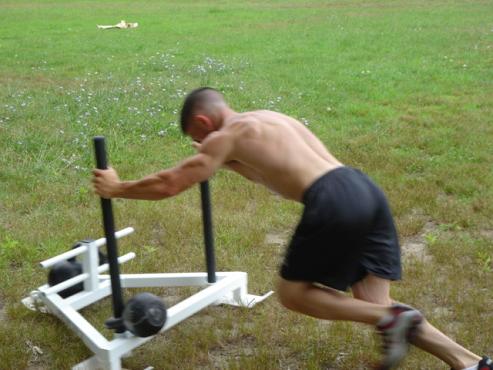
    The Prowler is a great tool for developing General Physical Prepardness (GPP), explosiveness, and speed. In this video, we demonstrate a warmup using the Prowler that will really get you sweating early…

    [youtube]http://www.youtube.com/watch?v=Rtw0qT3L73Q[/youtube]

    If you are interested in purchasing a Prowler, check out Elite Fitness Systems.